Photo by Tamara Alvarez
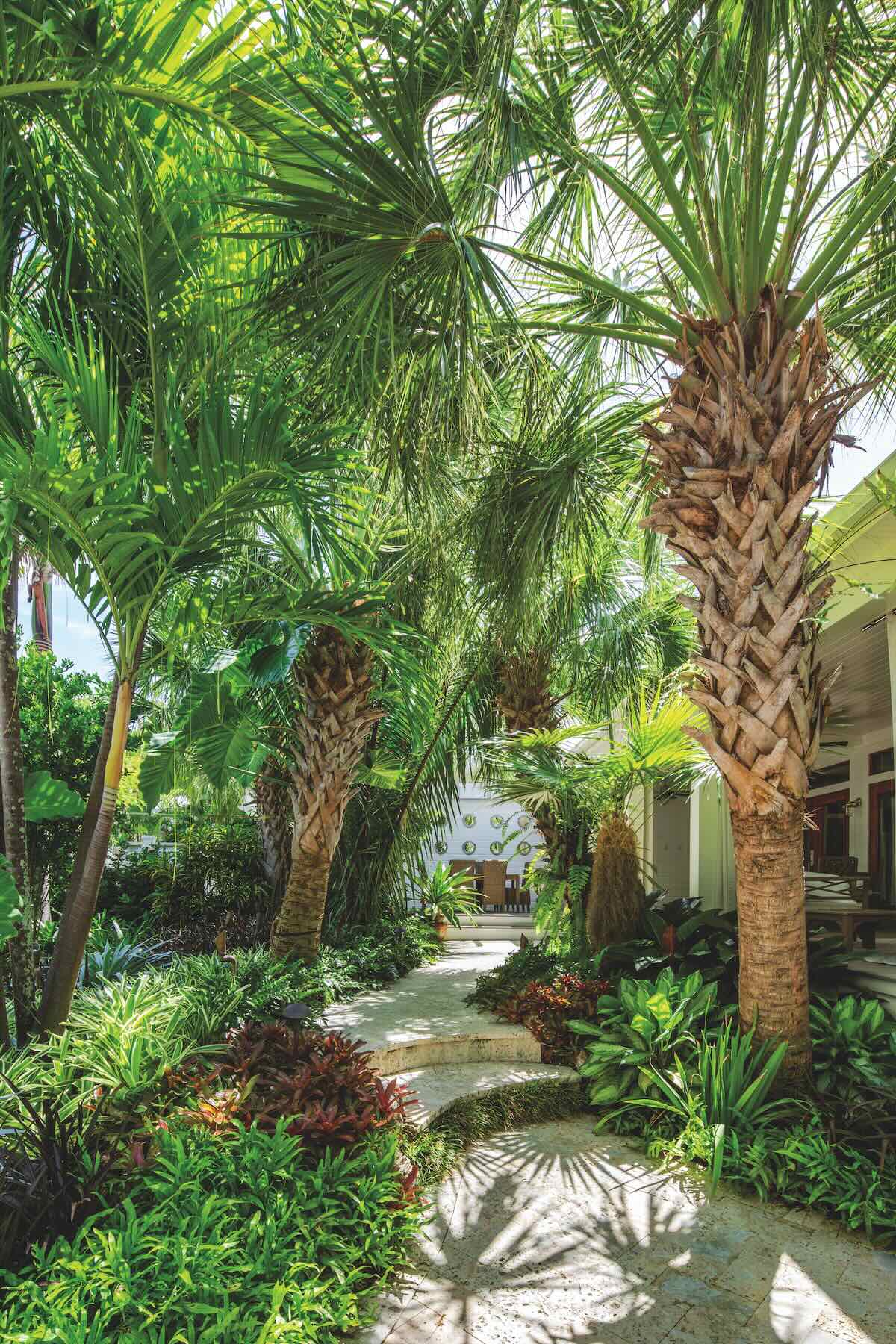
Along the pathway to the outdoor kitchen, the cross-thatch stem pattern on the sabal palms is repeated in the bromeliad leaf patterns in the beds below.
Rising to a challenge is what Craig Reynolds does best. Give him a tight lot with privacy-screening issues, and he’s in his comfort zone. Add in the necessity of accessibility for children, and he finds a matrix of answers in a web of easily traversed pathways while figuring in lounging spaces where adults can keep an eye on kids’ activities. But going above and beyond that brief is what really sparks Craig. In addition to answering the unique specs for site design in this Key West garden, he created a richly complex tropical paradise using a lush palette of palms, bromeliads, ferns, and other tropicals.

Photo by Tamara Alvarez
As a greeting along the front driveway, Osmoxylon lineare forms a hedge-like weave below thatch palms.
While the property originally had a few plants in residence, it also had some challenges. “There were piles of stacked limestone rocks—probably added as a barrier to reduce street noise,” Craig says. “It was a supreme mess.” His primary goal was to make the ⅓-acre garden feel spacious for the family’s eight children, but he also wanted to give the landscape some intrigue and a sense of adventure. In short, there was nothing simple about his plan.

Photo by Tamara Alvarez
The pool is surrounded by “islands” of tropical plantings and shaded by strategically placed palms.

Photo by Tamara Alvarez
Where the path forks near the guest house, ferns form a skirt around silver bromeliads and burgundy-leaved crinums.
Craig’s signature style harnesses the Key West tropical vibe and builds on it, often with a sort of surrealistic result. For this project, his design covers every square foot while creating meaningful connections among layers. Drama expands throughout the space with a cast of thousands of plants, but continuity is key. With very few blossoms, the garden dialogue happens between textures and colors in his choice of plant materials. “It’s about subtle leaf blush and foliar contrast,” says Craig. “If you feel as if you’re dwarfed in a massive leafy arrangement, that’s exactly the intent.”

Photo by Tamara Alvarez
The path from the guest house to the pool is punctuated by a stately silver Bismarck palm above the feathery texture of pygmy date palms.
Creating a sense of adventure was anything but straight-forward. Although linear pathways were necessary for accessibility, Craig juggled the challenge of maintaining that sense of expansiveness while also delivering the “conceal and reveal” drama he loves to weave. “Working in Key West, we learn to tightly pack plants for privacy while also giving the garden a spacious feel,” Craig says. His trick is to layer under-story plants against midrange and overstory players. To keep the display from feeling dizzying, he masses plants—especially groundcovers—and then creates periodic color accents to move the eye along. There’s soothing repetition but also special highlights.

Photo by Tamara Alvarez
Areca and lady palms underplanted with crotons perk up the path to the spa and outdoor shower.
For his plant palette, Craig reached beyond Florida natives to expand into true tropicals from the Caribbean. Although there’s an inherent density, it’s all carefully defined. “The garden should always look thoughtfully finished,” he says of walking the fine line between wild and cultivated.

Photo by Tamara Alvarez
Coral-stone coping frames a spa surrounded in clusters of aglaonemas and palms.
Deep knowledge of the climate and the plant material is Craig’s not-so-secret superpower. With the help of his studio associate Alex Thommes, he selected palms not only based on their beauty but also on how they would mature to deliver the desired density. “As you walk through the garden, you experience a conversation that gradually reveals itself,” says Craig. “The scene is rich and full; it’s almost like a pointillist painting.” And although the property has changed hands over the years, Craig and his team remain involved to tweak the scene and maintain the experience. As a result, the garden just keeps growing better.
PALM VARIETIES
Think of a tropical paradise, and palms set the stage. As Craig Reynolds Landscape Architects was adding the layers to this Key West enclave, the knowledge of the firm’s palm expert, Alex Thommes, came in handy. With his own collection of over 40 species, Alex modestly calls himself a “hobbyist.” But his knowledge goes far beyond the palms he personally stewards. Alex knows which ones read best planted in clusters and those that make stand-alone statements. He can predict growth cycles and maturity times. And he understands interrelationships between palms and the surrounding flora and garden design. Some notable palms include:

Photo by Tamara Alvarez
PHOENIX ROEBELENII (dwarf date palm): When choosing palms to fill a role in the garden, Alex considers more than just the fronds. Not only is the dwarf date palm appropriate for either a sunny or shaded location, the textural “boots” (remnants of frond attachments) lining the trunk add further visual appeal.

Photo by Tamara Alvarez
SABAL PALMETTO (cabbage palm): The fact that the durable, nearly indestructible Sabal palmetto is the state tree of Florida says it all. Not only is it resilient, it’s also sculptural and multifunctional—and relatively inexpensive. “Ferns and orchids can grow out of its boots, making a living totem in the garden,” Alex says.

Photo by Tamara Alvarez
COCCOTHRINAX CRINITA (old man palm): With tip-to-toe interest, the old man palm’s swollen trunk is covered in a dense beard that lasts its long lifetime. This slow-growing native of Cuba has a handsome palmate, fan-shaped leaf.

Photo by Tamara Alvarez
ATTALEA COHUNE (American oil palm): Alex plants this “incredibly robust stand-alone specimen,” for impact. “It catches your eye, dwarfing everything else when it starts to mature.” To Alex, the long fronds “give the appearance of a massive feather duster.”

Photo by Tamara Alvarez
CHRYSALIDOCARPUS LUTESCENS (areca palm): To provide screening, especially along a property line, Alex enlists the multi-trunking Areca palm. Not only is it sufficiently affordable to plant in masses, it also is stoically hardy against tropical storms.
By Tovah Martin