California-based floral designer Max Gill calls himself a botanically inspired stem bender. “I find my greatest design inspiration in the natural process I observe in the woods during a hike or in my own garden,” he says. “I notice how plants interact with each other and their environmental conditions, and it’s really their competition for optimal conditions that influences their spatial dynamics.” He looks at how plants reach for the sun or the manner a vine wends its way up and around a tree. “Something special happens when the plants have to fight for it a bit. The struggle brings a new dimension or character to each stem and tells a story I want to capture in my work. If I can make an arrangement appear as if it grew on a windswept hill or all the elements are angling for the same light source, that’s when I find my happy place,” he says.
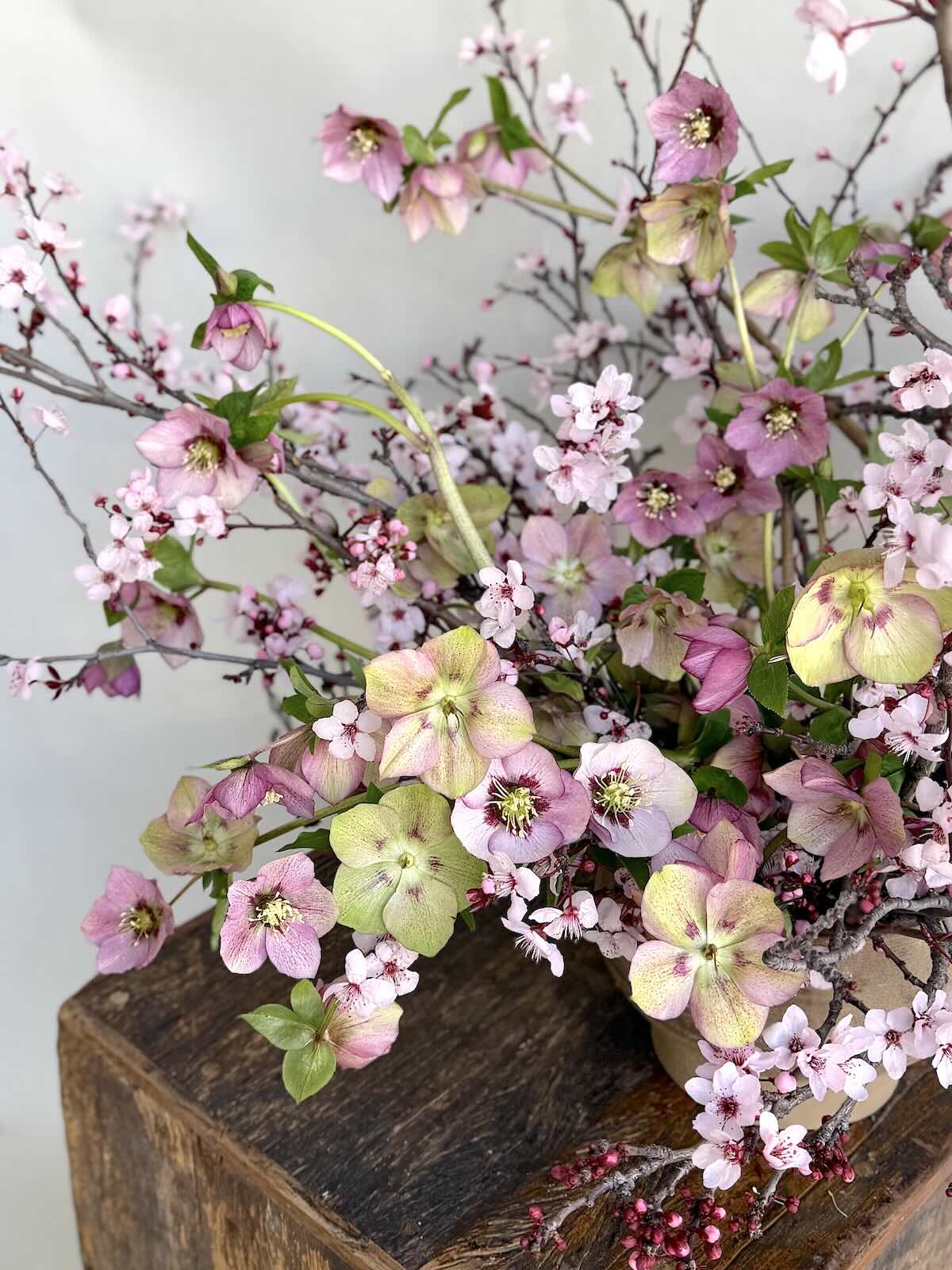
Photo courtesy of Max Gill
Around November, Max turns to hellebores for inspiration, as soon as they begin rambling around his Oakland garden, where they’ll continue their enthusiastic performance long into the spring months. “It’s lovely to find a hero flower for arrangements during a time of year when not much else is blooming,” he says.
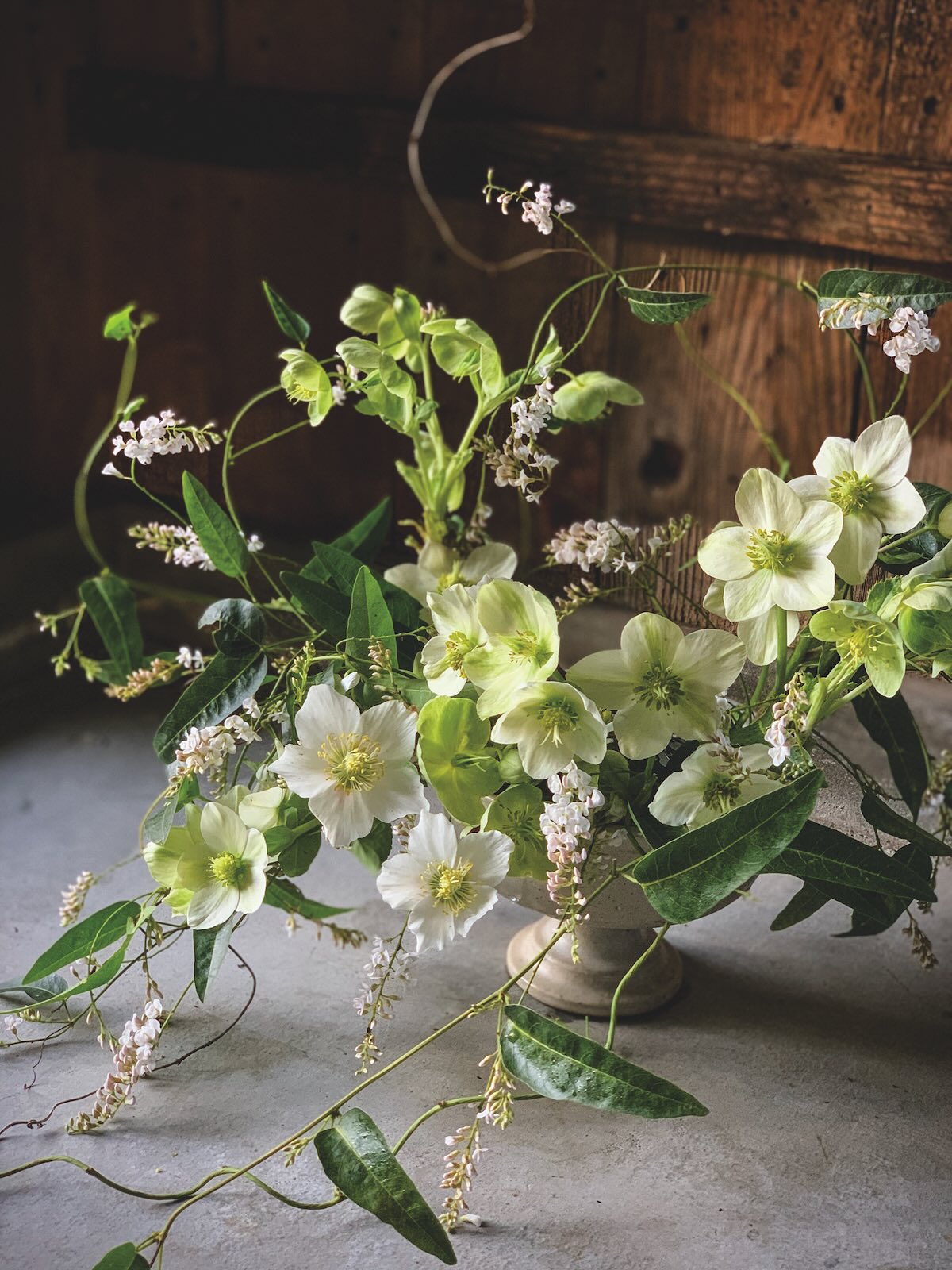
Photo courtesy of Max Gill
"Hellebores are nodding flowers. There is something so appealing about that modesty,” says floral designer Max Gill. “They are lovely when you see their face, but they also provide a beautiful profile when they bow. I pair them with anything woodsy or textural, which I’ll often use to help prop their heads up. I do a lot of fiddling with hellebores when I need them to bend to my will.”
Max’s Tips for Working with Hellebores
Garden Variety: I personally find the standard helleborus orientalis varietals [commonly referred to as Lenten roses] the most refined and they remain my favorites. There are so many different kinds. They also reseed pretty readily, so I always have multiple generations going on in the garden. Sometimes it takes three years for one to bloom and it doesn’t always turn out to be what I’d expect. But what does gardening teach us but patience, and three years goes by either way—I might as well be tending to some hellebores. And now there are also a lot of the newer hybrids that are much more vigorous, with all kinds of doubles happening, where the sepals almost turn into tutus or a ruffly moment in the center.
On Conditioning: Once a hellebore has gone to seed you get the most life out of it. But then you get the pods and not the stamens—and that center is just so captivating. I’ve been told all kinds of tricks to make them last longer, from dipping the ends in boiling water to scoring up the stem, but I don’t do either of those things. My method is to use FloraLife Hydraflor—it’s a caustic solution intended to kill the bacteria that makes cut flowers wilt. I do it as a pre-treatment, but I also put a very tiny bit in the water of the arrangement itself. I also learned another method from Sue McLeary (@passionflowersue), who is a wonderful floral designer and educator. She brought back something that’s actually an old-school floral conditioning technique: a hydration chamber, which sounds really high-tech, but it’s basically a plastic storage tote that you mist inside really well, mist the cut flowers, put the lid on it, and then put in the cooler. They drink a lot of water that way. Now I’ve started taking larger storage totes and turning them on their side so I can put the flowers in a bucket of water inside. I’ve had really good luck with hydration chambers for hellebores as well as other flowers, but HydraFlora is always my first line of defense.
Max Mechanics: Depending on the vessel and the arrangement, I often put a flower frog in first. And then on top of that, I create a chicken wire cage to secure and position the stems. Of course, mechanics for an event can be more complicated—when it’s in the back of our van during an hours-long drive up a winding hill to the venue, I want things to stay as tight as possible. At home I’m more apt to let them fall as they want to do.
Arranging Faces: Hellebores have a certain modesty—they’re nodding flowers. They’re lovely when placed to see their faces but also provide a really graceful profile when allowed to bow. Each stem tends to have a primary flower and then a few auxiliary buds around it that I often use to position the main flower so that it’s face forward. Or sometimes I use a small branch, vine, or fern frond to brace and prop up the heads to see their incredible centers. I do a lot of fiddling when I work with hellebores. In a worst-case scenario I’ll wire their heads up to make them behave and bend to my will.
Perfect Partners: Anything that’s really textural and feels woodsy pairs well with hellebores. One of the first floral design concepts I was introduced to and truly enjoy is repetition of a theme. I’ll combine hellebores with other flowers that have a similar form but in a different scale. Perhaps no one else notices, but it makes me feel very clever. We have a native wild plum tree that blooms around the same time and its flowers have a smaller, but similar shape. I have a picotee hellebore that has a dark plum center—it’s almost like someone took an airbrush and detailed it—which also becomes a repetition of color.
Parting Thoughts: Many people find arranging hellebores challenging because they can be so temporary and finicky. For me, that only makes them more precious and special and makes me want to pursue them even more. Flowers are all about the fleeting moments. Hellebores ask you to be present right then and there.
Don’t miss Tovah Martin’s dive into growing hellebores and new hellebore varieties.
See more from Max at maxgilldesign.com and by following him on Instagram @maxgilldesign.