Photo by Chris Benzakein at Floret Flower Farm
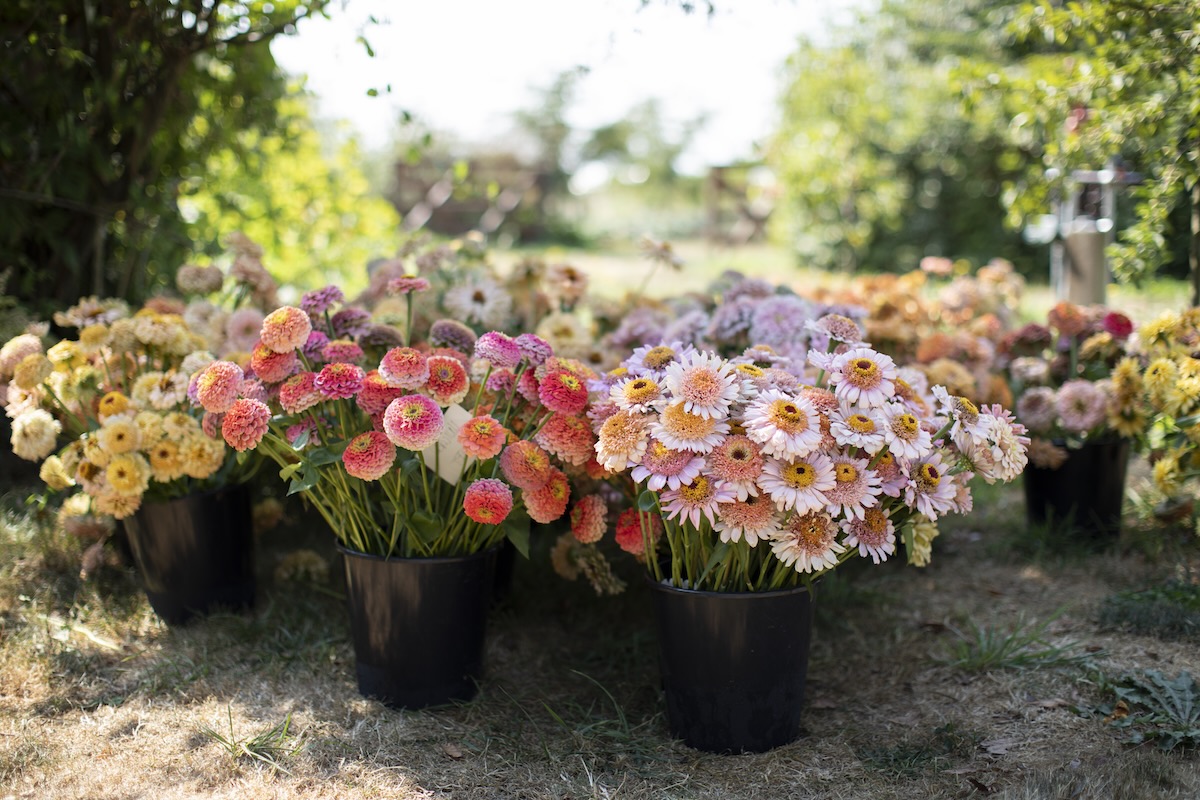
Freshly cut zinnias at Floret Flower Farm hint at new colors and forms for this garden classic.
Zinnias, those bright, cheerful flowers of the summer garden, are getting a makeover. Within the past few years, more sophisticated hues of Zinnia elegans have become available. Romantic pastels, glowy peaches, and soft neutrals offer an alternative to the saturated primary colors of traditional zinnias.
For the most part, these new zinnias are coming from backyard and small-farm breeders who share information, mostly online, in a spirit of friendly collaboration. No one expects to get rich; zinnia breeding is purely a passion project. (It’s not particularly difficult, so if you’re looking for a new garden obsession, see Breed Your Own Zinnias below.)

Photo by Chris Benzakein at Floret Flower Farm
An ombre collection of Floret Originals Zinnias captures an array of pastel colors and flower forms.
The aim of most breeders is to create soft colors that can be used for weddings and events in place of more expensive or difficult flowers like garden roses and dahlias. For others, the objective is to capture some interesting anomaly in the zinnia patch, such as quilled petals, irridescence, and bicolors.

Photo courtesy of Blomma Flower Farm
Tiffany Jones with softly colored, almost neutral 'New Parchment' zinnias

Photo courtesy of Blomma Flower Farm
The flowers of Blomma Flower Farm's 'Pearl Pink' zinnias are 4 inches in diameter.
Tiffany Jones of Blomma Flower Farm in Nevada has been breeding and selling seeds since 2019 and is the author of The Zinnia Breeder’s Handbook. She defines her zinnia goals this way: “I’m looking for an exceptional cut-and-come-again bloom that looks luxurious enough to be a focal flower, captivates the buyer, can only be bought locally, and will fill a market bouquet with fewer flowers. There’s no digging or storing; they are quick to germinate, take plenty of heat, don’t need a lot of water, and are exceptionally easy to grow.”
It may seem like a lot to ask from the humble zinnia, but these new cultivars are up to the job.

Photo by Lynn Byczynski
Lynn Byczynski's 'Prairie Peach' zinnia glows in the garden.
My own variety, ‘Prairie Peach,’ has peachy pink lower petals and pale yellow upper petals. The flowers are big and fluffy, and the pale centers make them glow in a bouquet. Plants are tall and strong, germination is robust, and seed is not expensive. Learn more about the development of ‘Prairie Peach’ on my website.

Photo by Chris Benzakein at Floret Flower Farm
Erin Benzakein with a truckload of Floret zinnias
At Floret in Washington, Erin Benzakein is working to develop a zinnia substitute for every possible imported flower, which would save florists money while boosting sales to local growers. “Rather than importing carnations or roses, I think there can be a lot more varieties of zinnias,” Erin says. “I have blush-colored zinnias in every shape and size, from the size of a marble all the way up to the size of a hand.”

Photo courtesy of Johnny's Selected Seeds
'Linen' zinnias, developed by Johnny's Seeds, produce dahlia-shaped flowers in flaxen tones.
The research farm at Johnny’s Selected Seeds in Maine introduced three new color mixes last year and another this year. They include pale pink ‘Ballerina;’ aptly named ‘Linen;’ peachy two-toned ‘Aurora;’ and sunset shades in ‘Agave.’
Hillary Alger at Johnny’s Selected Seeds says the breeding team there started selecting for unusual colors in 2018. “Over many years of trialing all sorts of varieties, we observed color variation in open pollinated mixes that did not exist in commercially available varieties. Specifically pale pink was a very intentional target, but other colors were as well, such as some of the more nuanced and muted hues found in ‘Agave’ and ‘Aurora.’ We set out to see if we could stabilize some of those special colors while also selecting for doubleness and a strong plant habit at the same time,” Hillary said.
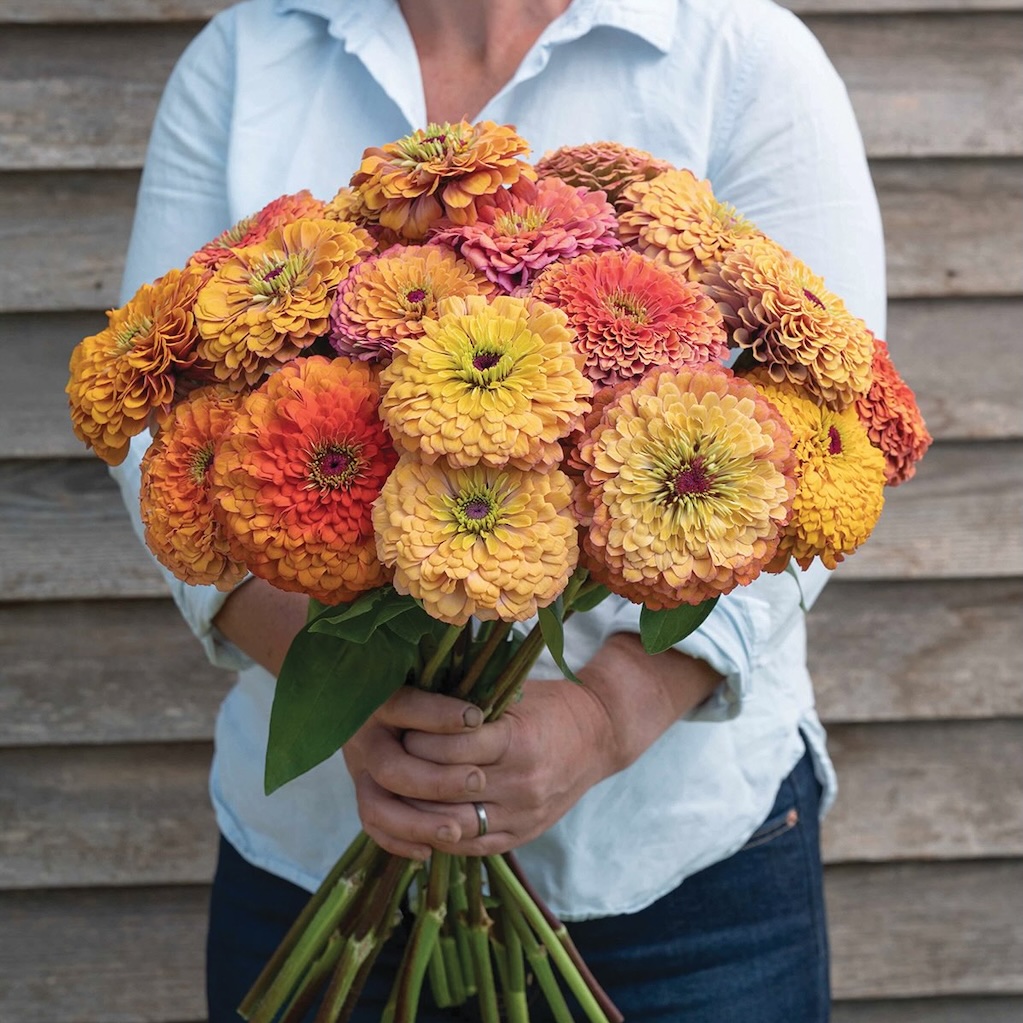
Photo courtesy of Johnny's Selected Seeds
'Aurora' from Johnny's Seeds has two-tone flowers with contrasting centers in shades of orange, gold, yellow, peach, and pink.

Photo courtesy of Johnny's Selected Seeds
Johnny's 'Ballerina' zinnia flowers have a blend of soft pink and pale peach.
For now, breeding cut flower zinnias is being left to the small growers. There’s just not enough market for big horticultural companies to invest the time necesssary. But that’s okay, because we are getting some very interesting zinnia genetics into the marketplace anyway. The door to the mystery and magic of zinnias has been cracked open, but there is much more to be done.
BREED YOUR OWN ZINNIAS
Zinnia cultivation is not complicated, but it does require patience, perseverance, and curiosity. Patience is needed because it takes at least six years to get a zinnia from first selection to seed sales. I started breeding ‘Prairie Peach’ in 2020 from an unusual flower that appeared in a cactus zinnia mix. It took me years to get the variety stable and have enough seed to sell. Perseverance is needed because you have to do the same thing over and over. While working on ‘Prairie Peach,’ I got tired of growing only one color of zinnia every summer, but I hung in there. You’ll need curiosity because this kind of plant breeding is unpredictable. There are no textbooks that tell you exactly what to do to get the result you want; you have to try various things and see what happens. Of course, you won’t know until the following year, so again, patience!

Photo by Lynn Byczynski
The fluffy, radiant, two-toned flowers of 'Prairie Peach' set Lynn Byczynski on the path of zinnia breeding.
Want to give zinnia breeding a try? The easiest place to start is by growing some of the new specialty colors alongside your favorite open-pollinated mix and let the bees and butterflies do the work of cross-pollinating them. Alternatively, you can start a breeding line any time you see a zinnia that seems exceptional to you.

Photo by Lynn Byczynski
Organza bags protect selected flowers from pollinators.
The first thing is to isolate your special zinnia so that it doesn’t get pollinated with “undesirable” pollen. By the time you find a great bloom, it probably has been pollinated already, so look for unopened buds lower on the same plant. Cover a few of them with organza bags, the kind used for jewelry or gift bags—they are readily available online. Tie the ribbon tight enough that insects cannot crawl in, but not so tight as to injure the stem and flower as they grow.
While those bagged flowers are developing into blooms, spend some time studying other fully opened flowers to learn hand pollination. Between layers of petals are wispy, y-shaped organs, known as the stigma or female part. On top of the flower are larger, star-shaped structures that contain the anther, or male part. Usually around mid-morning, the male parts will begin to shed pollen. Using a small artist’s paintbrush, sweep up pollen and transfer it to the female parts.

Photo by Lynn Byczynski
Lynn uses an artist's brush to pollinate zinnia flowers.
When your bagged flowers are fully open, you are ready to pollinate them. You can move pollen from male to female on the same flowers, but you are more likely to get viable seed if you transfer between flowers—especially if you have another plant with the same characteristics you like.
Repeat every day for a week to increase your chances of success. Then just relax and let the covered blooms grow old in their little bags. Once they have dried, cut them off and bring them inside to finish drying.

Photo by Lynn Byczynski
A basket of dry zinnia flowers ready for seed harvesting
Once dried, you can cut off the petals, break apart the flowers, and extract the seeds. Plant those seeds the following year and hopefully you find a few that looked like your original bloom. Isolate those, pollinate them, save the seeds, and repeat the next year.
For the sake of brevity, I’m skipping over a lot of nuances here, but you’ll find many more details on my website, Flower Territory.
SOURCES FOR ZINNIA SEEDS
- Available seeds as of publication include my own variety, ‘Prairie Peach,’ available from our family’s seed company, Seeds from Italy.
- Also available are new selections from Johnny’s Selected Seeds.
- A breeding mix is available from Dawn Creek Farm. The breeder, Kori Hargreaves, calls it a fundraiser; read the details on her website.
Sign Up for Seed Sales
Several other small breeders offer their seeds once a year and they sell out fast, so you have to get on their mailing lists to know when they become available.
- Blomma Flower Farm will sell seeds during a short window in January 2027.
- Windfall Flowers in British Columbia, Canada, will have seeds for sale in fall 2026.
- Floret has paused seed sales while working to stabilize their varieties. Their website is packed with useful information about zinnias.