Photo by Barbara Zacharay
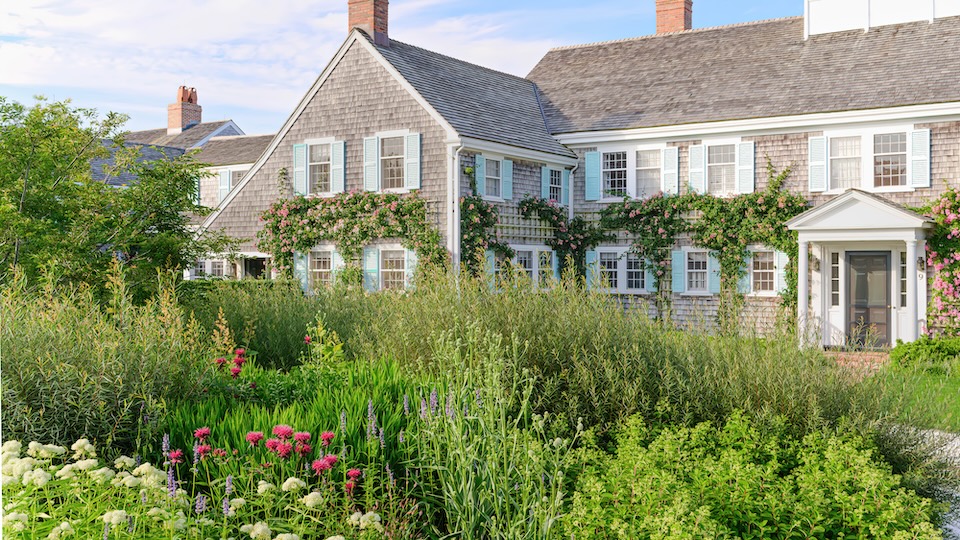
Pink roses scale latticework on a traditional Nantucket home, while further from the house the edges of plantings are blended with native plants.
While walking down the cobblestone streets on Nantucket, many admire the gray-shingled stores, whaling-era architecture, and hydrangeas along every corner. Anyone who visits knows there is a certain je ne sais quoi to the charming island, and landscape designer Julie Jordin understands it all too well.
While I was on the island for the first time over the summer, I couldn’t help but fall in love with the design of it all myself. It wasn’t long before I learned about Julie’s talents and saw the results of her work. She joined me for a conversation about what it’s like bringing residents’ dream gardens to life in a dream town.
FLOWER: You’re known for doing incredible landscape and design work in the New England area. Are you from here?
Julie: I was raised in Pennsylvania, where I started working in nurseries and the landscape business at the age of 14. I went to Penn State for landscape contracting and design horticulture, and I came to Nantucket for an internship—then I met a boy here. I wasn’t sure if I was going to stay, but the soil was so sandy, and people really appreciate the aesthetic of landscape here in a way that wasn’t present in Pennsylvania. But when I got out of design school, no one was like, ‘Here’s my multi-million-dollar Nantucket estate; have at it.’ So I started a gardening business, and then I started designing landscapes. I’ve raised my children here on Nantucket and have now lived here for 30 years.
Courtesy of Julie Jordin
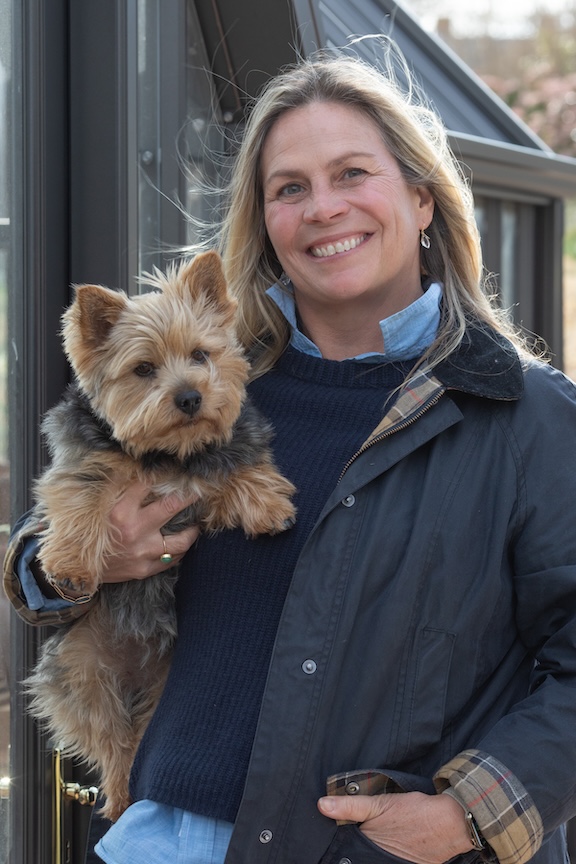
Landscape designer Julie Jordin has a great team that works alongside her, including her adorable dog.
You started out in the industry at a very young age. What caught your interest?
When I was a small child, my great-grandfather and my grandfather had dueling gardens across the street from each other in my parents’ hometown. My great-grandfather also went to Penn State for an agriculture certificate and got out right in the ’30s at the advent of the grocery store. He was going to be a farmer but ended up having a service station with a one-acre garden behind it. He was a biodynamic gardener because they didn’t have pesticides back then. However, my grandfather was into Silver Bullet and the chemical companies. So I was raised with this dichotomy of the horticultural industry, and I use a lot of my great-grandfather’s adages even to this day.
How do you approach landscape design with your clients?
There’s this aesthetic connection that involves helping people really see green in a positive way. Everybody sees things a little differently, but my goal is to connect the client with their land in a way that really makes their hearts sing and their space feel happy. I’m always trying to incorporate good design, good structure, and good aesthetics. Creating landscapes for families now is very unique. The nature of the work has led to it being very collaborative. I’m a woman–owned business with all women working for me. We use contractors, certainly, to create all the stone walls and the pools and all of that, but my in-house team is women collaborating around planting design and family entertaining spaces. And as moms, we bring a lot to the table because we know what makes gardens much more livable for families. We can explain things like why you don’t want a beach path that’s too narrow because you’re walking through with a lot of people and a lot of stuff and you’re worried about ticks. We get it.
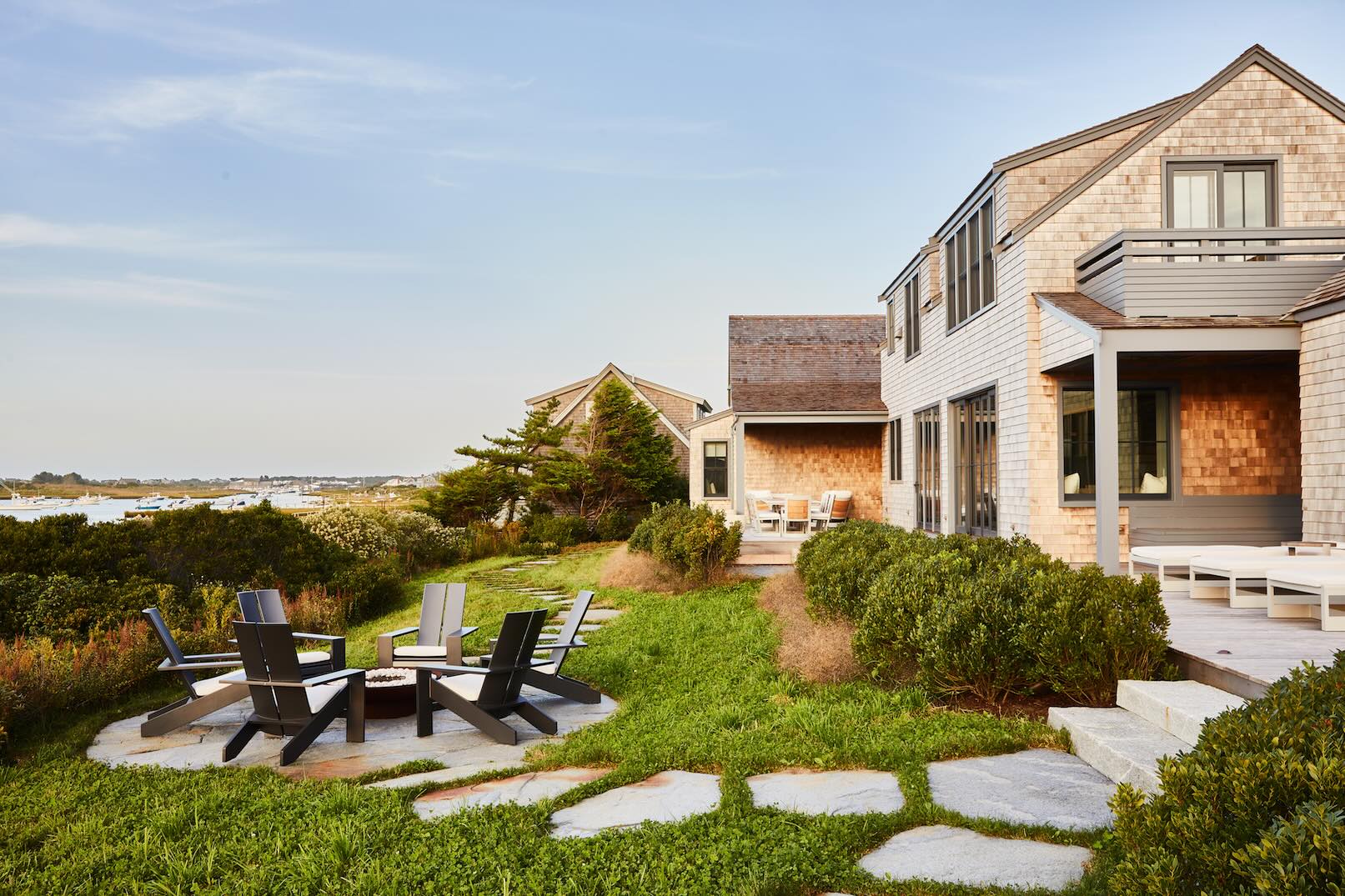
Photo by Matt Kisiday
Julie designed a stone walkway leading from the house to a patio and cozy fire pit overlooking the water.
What does your design process look like when creating a space for others?
We talk a lot about how they’re going to use the space. I’m painstakingly practical. I’m really into things such as having a driveway that works, having great flow to the kitchen—all of that stuff works to make the end result effortless in a way. And then we get into the fun stuff like the fire pits and the spaces for playing ball. We look at what they need in order to have the lifestyle they want on their little, or big, space. But you also have to ask the hard questions. If you’re only dealing with half an acre and you give me a big list of programming, then we have to sort those things out and see what’s really going to be the best bang for your buck when you have to choose. To make a great garden design, you have to have a clear intention. What is it you’re actually going to use and gravitate towards? What will bring your family closer together? What will bring you closer to nature?
Working outside and working with plants is a dream for many people. What do you enjoy most about it?
I think I enjoy the patience it takes. The real stick-to-it-intuitiveness that is involved when making a really great garden. Most projects I start take anywhere from 6 months to 2 years. I love the design process—from figuring out what spaces they want to be in right down to plants that were in their family history. I love that whole aspect of it. But also, I love creating plant communities. I enjoy going back to a design I worked on and seeing what is thriving and what’s interacting with what—and knowing it was all once an idea on a paper. That’s really a special thing.
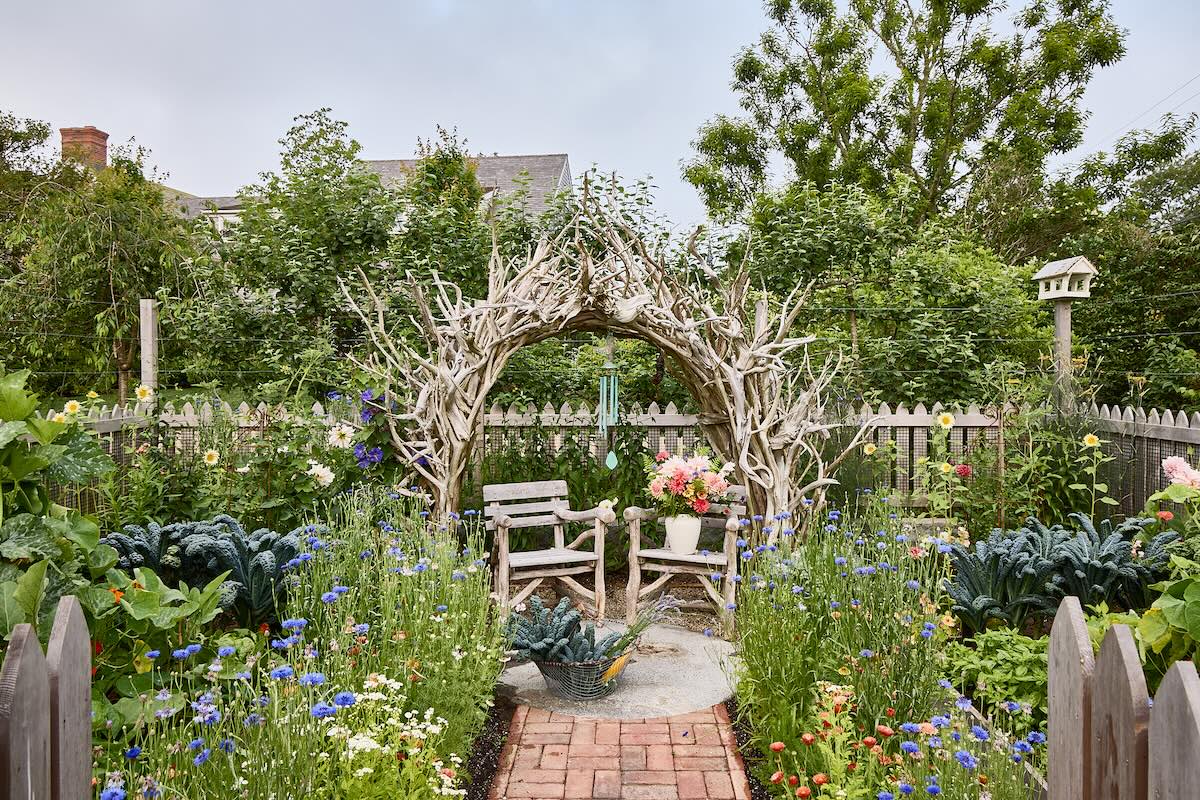
Photo by Matt Kisiday
Found objects are used to make spaces feel rooted in history. Here a magical driftwood pergola anchors an herb and flower garden.
Do you have a signature style you bring to your landscape work?
What I like to do is try to marry the ecological knowledge I have about plants with the client’s aesthetic. If someone will let me learn about them and their family, I can marry that knowledge with what I know about horticulture and make a very distinct, personal space for their family while also considering the site and ecological benefits of, say, native plants. And I can work in Grandma’s peonies, the patio, the pool, and other wishes. Closer to the house, I really try to have things that are more personal and more cultivated. But as you get away from the residence, I like to blend the edges with nature.
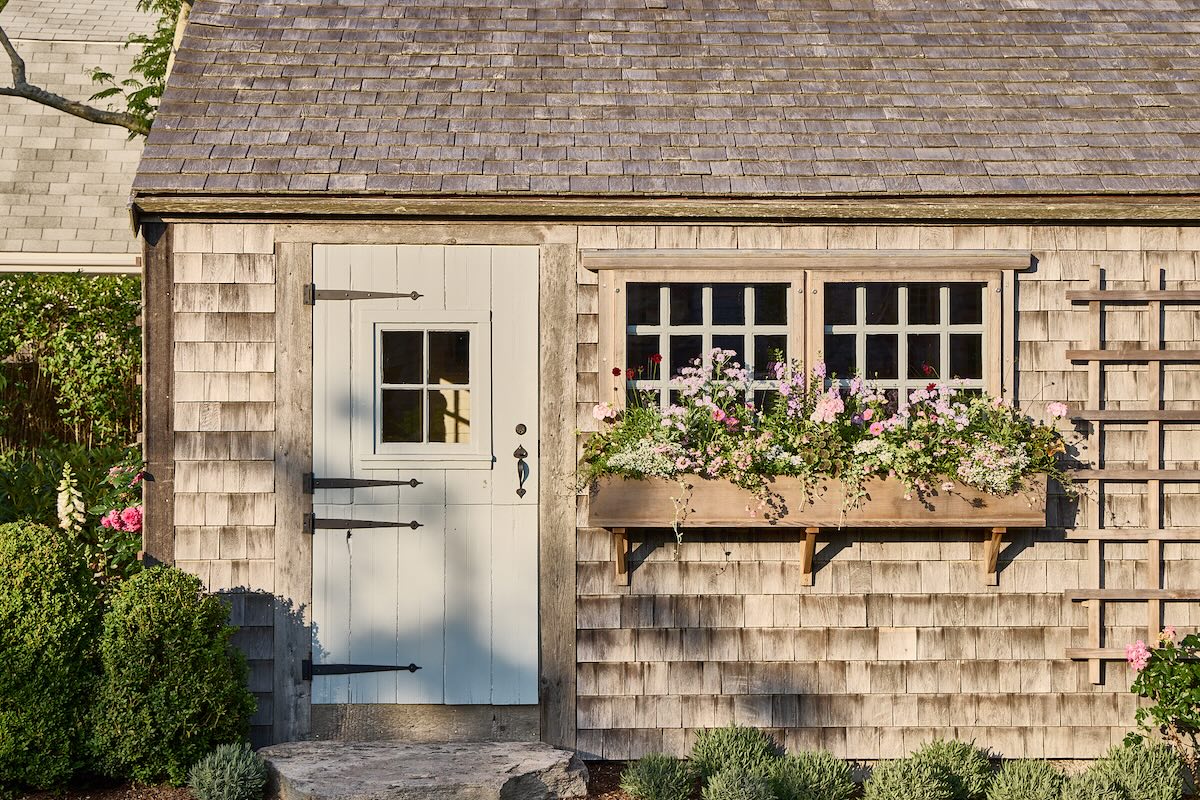
Photo by Matt Kisiday
"I like the gray shingles here cause you to lean into details and aesthetics a little more only because everything’s the same color," says Julie.
What’s your formula for creating that balanced and beautiful landscape design?
Good structure makes everything else easy. You need to figure out how you’re going to ground whatever architecture you’re working with into the land and how the people will move through it. If you have great bones, then you can embellish and create plant communities that will flourish in that area. I really love to marry that architecture down into the earth and try to connect everything with the plants and the flow of the people. There’s a lot of scaling that goes into it. People will call me and say, ‘You designed so-and-so’s pool. What size is that pool?’ They think it’s the perfect pool, but it’s the perfect pool for that space. It’s all about scaling to the natural area and balancing the natural area with the programmed area. You don’t want to look overdone, over-furnished, or even over-planted. You can actually go too far with the planting. Creating that balance where humans are immersed but their needs are being met in the correct space is very important because every space is different.
Do you have a house or a landscape that is one of your favorites or a standout in recent years?
I have a bunch of them! There’s a really good one that I did twice. I designed it the first time for a family from California who had a very refined aesthetic—no color and a modern look. Then the house sold and a really nice couple from Atlanta bought it. They wanted more embellishments such as fire pits and a pool. Both families were amazing to work with but were very different people. I just finished another really nice project that was a very tiny house. It was in my client’s husband’s family for generations, but they were going to have to sell it, so she and her husband purchased it for the family. It’s right on Brand Point at the foot of the cliff. We did a naturalistic garden that really leans into the cottage garden aesthetic. And we tried to do a lot of it for the birds. We took all the privet hedging out and put in natural hedging that was very diverse and flowering buds that contribute to the native corridor projects. Then we added little gardens and hydrangeas and things that were personal from the history of the house. We added a cute swing set; a big, old-fashioned-looking barbecue; and a dining pergola. It really packs a lot of power for how small it is. And it’s contributing to nature. Everything looks like it belongs there.
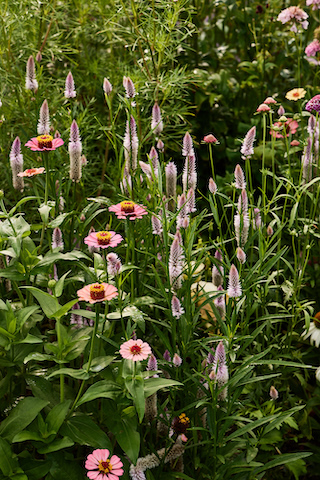
Photo by Matt Kisiday
Pink Zinnias and Celosia brighten a garden border.
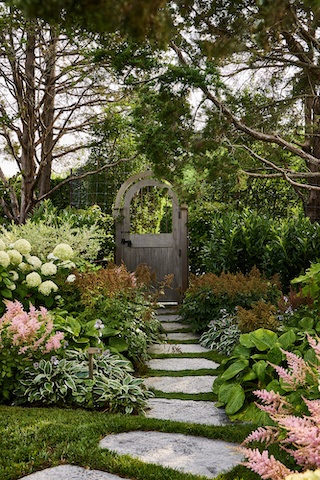
Photo by Matt Kisiday
A flagstone walkway between beds of hosta, astilbe, and hydranges leads to a charming arched gate.
A lot of people look at Nantucket and that area as a source of inspiration for their own design, both interior and exterior. What do you think it is about the environment that makes it so special?
As a young designer, I was lucky to move somewhere with this super refined aesthetic. I definitely cut my design teeth on some of the toughest critics. I worked for Jean Halberstam, whose husband, David Halberstam, wrote the book The Best and the Brightest. I designed her all-white garden, and it was fabulous—full of Casablanca lilies. And I did a Rose of Sharon hedge. I would say the refined aesthetic in Nantucket is grounded in history. Things are very thoughtfully considered—spatiality, scale, all of that—so that there’s a real sense of place and a sense of old. Even if someone’s really into a modern landscape, I try to bring it down with some found objects to make it feel rooted in history in a way. Also, I think the gray shingles here cause you to lean into details and aesthetics a little more only because everything’s the same color. It’s not like you have a yellow house next to a purple house next to a modern design. Because our historic district has really paid attention to what Nantucket Shaker style should look like, it’s a really great base for excellent design.
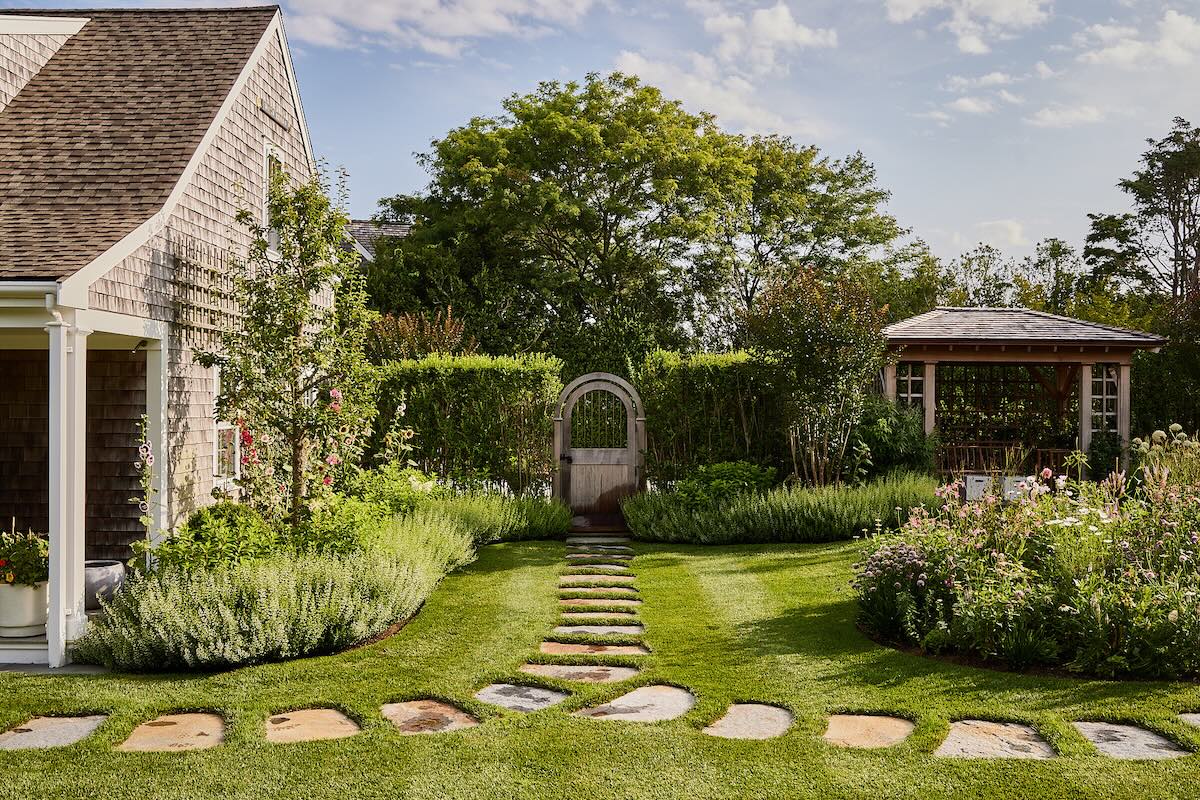
Photo by Matt Kisiday
Julie carefully considers how each space is used. She notes, "I really love to marry that architecture down into the earth and try to connect everything with the plants and the flow of the people."
You’re always working on other people’s homes, but do you ever get time to have fun with the landscaping at your own home?
I have people doing edging in my driveway right now. But until the last couple of years, it’s been a test ground for different plants and things like that. Recently, I’ve had a little more time to really enjoy leaning into my garden and experimenting with things. I love natural things, and I love natural processes. I have a stand of milkweed literally right outside my garden. And I have about 15 monarchs that are about to make their little J shape and turn into butterflies. I try to keep things very low maintenance at my house. I understand how to build structure and maintain structure for my clients, but it’s not something I need at my own house.
An outdoor space can really become someone’s sanctuary. What does it mean to you to be able to create such a special part of someone’s home?
I love seeing my clients in their space. I love stopping by to check on something and seeing the grandchildren running in the grass with the bubble maker on. I plant very full gardens, and I don’t get sad if something doesn’t work—we just try again. I have the right disposition for my job, and I have enough experience with plants to know how things work. Sometimes you’ll do a garden and the deer won’t touch the plants, and then you do a garden on the other side of the island with the same plants, and the deer love it and ravage it. So you do have to keep trying. Not every plant here is guaranteed to love your spot. With my breadth of knowledge, we are going to get it pretty close, but I tell my clients to be open to the idea that maybe a plant doesn’t like your space. It’s all part of the process, and we’ll keep going.