Photo by Alex Ramsay
Traditionally, Italian Gardens feature structure, geometry, greenery, and statuary rather than exuberant displays of flowers.
If you love a straight allée, thank Rome—because that’s where the axis was born. When American landscape architects went searching for inspiration, they turned to Italy. There, design was rooted in the history of the Renaissance when cardinals, popes, and the wealthy first copied ancient Rome to create gardens beyond simple sustenance. And when the Italians added landscapes to their villas and palazzos, splendor and magnificence were the goals. Not only did they infuse architecture into the landscape, but they used every sort of engineering to send water where they wanted it to rush while also imbuing their gardens with brilliant tricks of perspective to maximize views. The Italian garden was a place of incredible awe and majesty where showmanship was omnipresent. Making a similar splash is far beyond the means of most modern gardeners. But the axis, its focal point, and the fantasy live on.

Photo by Adam Eastland Art + Architecture
Villa Lante in Bagnaia is known for its rill shaped like gambero (crayfish), the symbol of Cardinal Gianfrancesco Gambara, who began constructing the gardens in the 1560s.
HALLMARKS OF THE STYLE
With so much natural beauty blessed with an agreeable climate, the obvious step was to extend the living space outdoors—after all, Italy is the birthplace of the room with a view. No longer limited to the walled monastery, views could frame the agricultural distance. While researching ancient Roman gardens, Renaissance designers rediscovered the strong central axis—ultimately dissected by cross axes—as a tool to send the eye gazing at a focal point. The rolling terrain led to some spectacular applications. Balance and symmetry were everything. Walls with archways, well-placed columns, and other architectural conceits framed the views. Drama ruled, and statuary told the story. Fountains, pools, and the art of sending water cascading down rills became such a fixation that finding sufficient hydraulics was a competition. Loggias and amphitheaters lured visitors outside to witness the splendor.

The gardens of Palazzo Borromeo on Isola Bella feature citrus trees, flowering shrubs, and ornamental hedges planted on terraces that cascade to Lake Maggiore.
ELEMENTS THAT ENDURE
When legendary American architect/landscape architect Charles A. Platt made his grand tour of Italian Renaissance gardens in 1892, he found inspiration galore. He grumbled that many villas were no longer in perfect repair, but still, enough survived to influence his noteworthy career. In fact, elements of those Renaissance gardens still rule. Although the overwhelming showmanship and blatant display of wealth and power in Italian Renaissance gardens might not be within our reach, concepts born in the 1500s have become part of our vernacular, beginning with garden rooms as a means of segmenting spaces. In addition to the axes that still appear in formal spaces, our penchant for using statuary (particularly gods and goddesses) as focal points, along with our love of water features in their many iterations, can be traced back to a fascination with Italian gardens.
THE PLANT PALETTE

Italian gardens incorporate green architecture, such as the tall, linear cypress (Cupressus sempervirens).
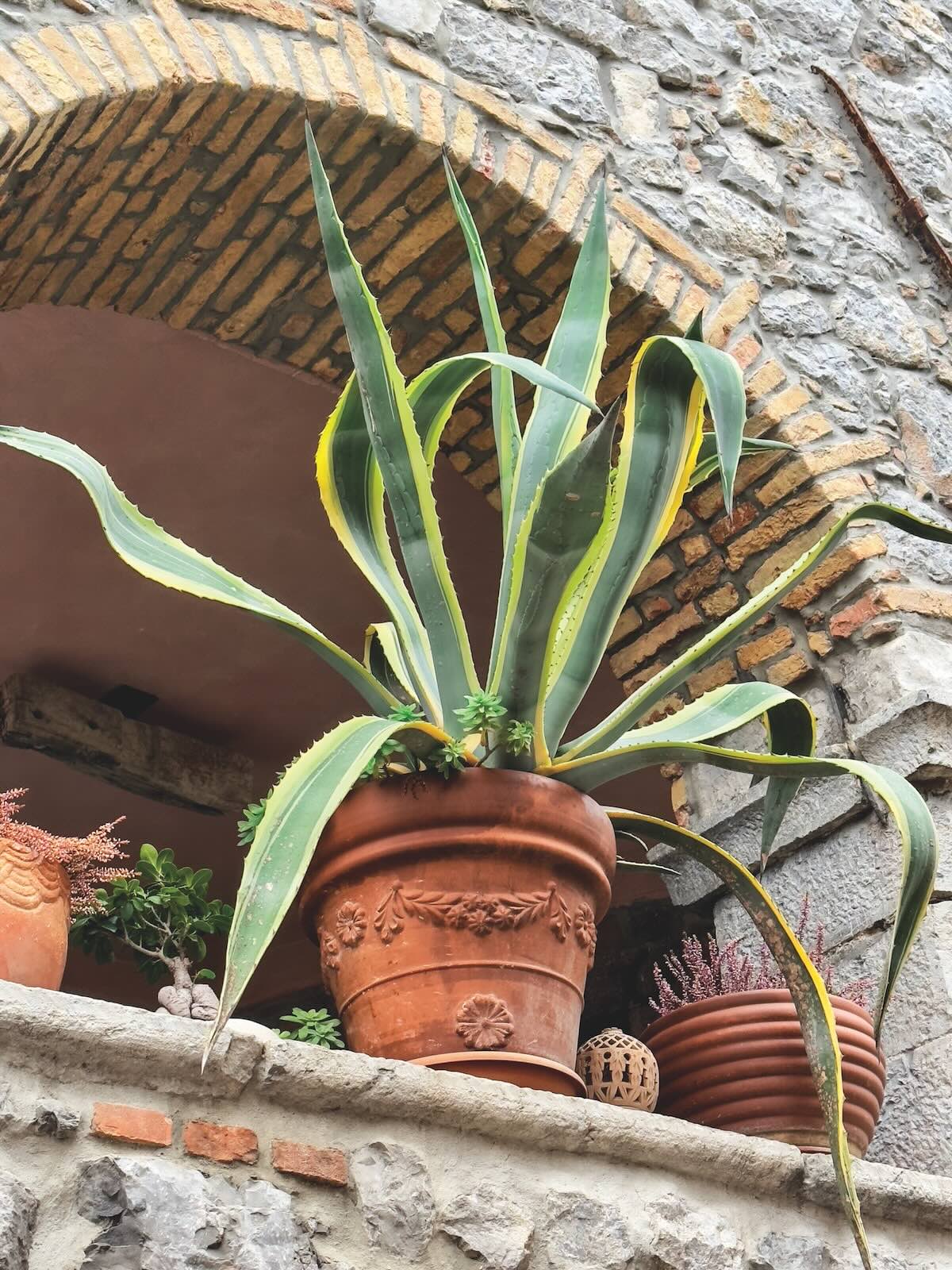
Photo by Sun | iStock
Strongly architectural and often grown in accent containers, agave (Agave americana) was introduced to Europe in the mid-1500s and became a symbol of wealth.

Boxwood (Buxus sempervirens) defines space and creates a broderie of hedges.

Photo by Matthias Rabbione | iStock
Olive trees (Olea europaea) soften lines and bring elements of the distant "borrowed" landscape into the foreground.

Photo by Bonnie McCann | iStock
Mediterranean herbs such as sage, sweet bay, and rosemary add texture and fragrance.
HISTORIC INFLUENCERS
LEON BATTISTA ALBERTI Artist/architect/author Leon Battista Alberti ushered in the Renaissance garden. Using his architect’s eye, he suggested exactly how the outdoors should be presented—harnessing the rolling terrain to create landscapes that beckoned outdoor adventure. Envisioning axes, hedges, walkways, and views, he was the father of the formal garden.
PIRRO LIGORIO We owe Pirro Ligorio for first creating the iconic Italian water cascades. At Villa d’Este in Tivoli, 20 miles from Rome and on the ruins of what was originally Hadrian’s Villa, Ligorio designed a dramatic fusion of art and nature with ample mythological statuary thrown in. Visitors walked from the bottom of the site through planted tunnels to emerge at dramatic fountains—all part of a narrative in a larger dialogue.
GIACOMO BAROZZI DA VIGNOLA Giacomo Barozzi da Vignola had much to do with the brilliance behind Italian Renaissance gardens. One example is Villa Lante, where he masterminded a dramatic water chain through a series of carved shells with loggias and colonnades to offer rest to the weary and provide vantage points. With symbolism galore, it was all meant to convey the power struggle between art and nature.
NICCOLÒ TRIBOLO Niccolò Tribolo specialized in massive dramatic statuary. When Cosimo de’ Medici came to power in Florence, he immediately hired Tribolo to design Boboli with not only a confection of mythological statuary and hydraulics but also as a pageant of rare plants including quantities of trees forming block-like groves. All was meant to convey Medici’s affluence.
BERNARDO BUONTALENTI Also working for the Medici family in Florence, Bernardo Buontalenti was the brilliance behind the phenomenal grotto at Boboli. Showcasing the talents of the Renaissance’s finest sculptors (including Michelangelo) and artists, Boboli’s grotto is a showpiece of mystery and magnificence with a combination of faux barnacle-encrusted walls and dreamily painted domes dramatically lit from above. In addition to his contribution to art and garden design, Buontalenti also invented gelato.

Photo by NGOC MINH NGO
Italy's romantic nature is on full display at the Garden of Ninfa, where medieval ruins were transformed into a botanical sanctuary by the Caetani family.

Sculptor Stoldo Lorenzi's "Fountain of Neptune," Roman god of freshwater and the sea, at the Boboli Gardens in Florence.
PLACES TO VISIT
VILLA D’ESTE IN TIVOLI Only 18 miles east of Rome, the town of Tivoli dives deep into history. Villa d’Este, the palazzo of Cardinal Ippolito II d’Este, began in 1550 when d’Este hired architect/landscape architect Pirro Ligorio. Beautifully restored, it’s a sterling example of the Italian genius for terracing and the use of waterplay with waterworks and fountains aplenty amid the loggia.
SACRO BOSCO IN BOMARZO In his grief at the death of his wife, Italian military leader Vicino Orsini hired architect Pirro Ligorio to orchestrate a Parco dei Mostri—a park of monsters. Created from 1552-1585, the woods are home to a truly remarkable collection of grotesque statues, the most memorable being what has become known as the “Mouth of Hell”—a gaping mouth sculpture built into the hill.
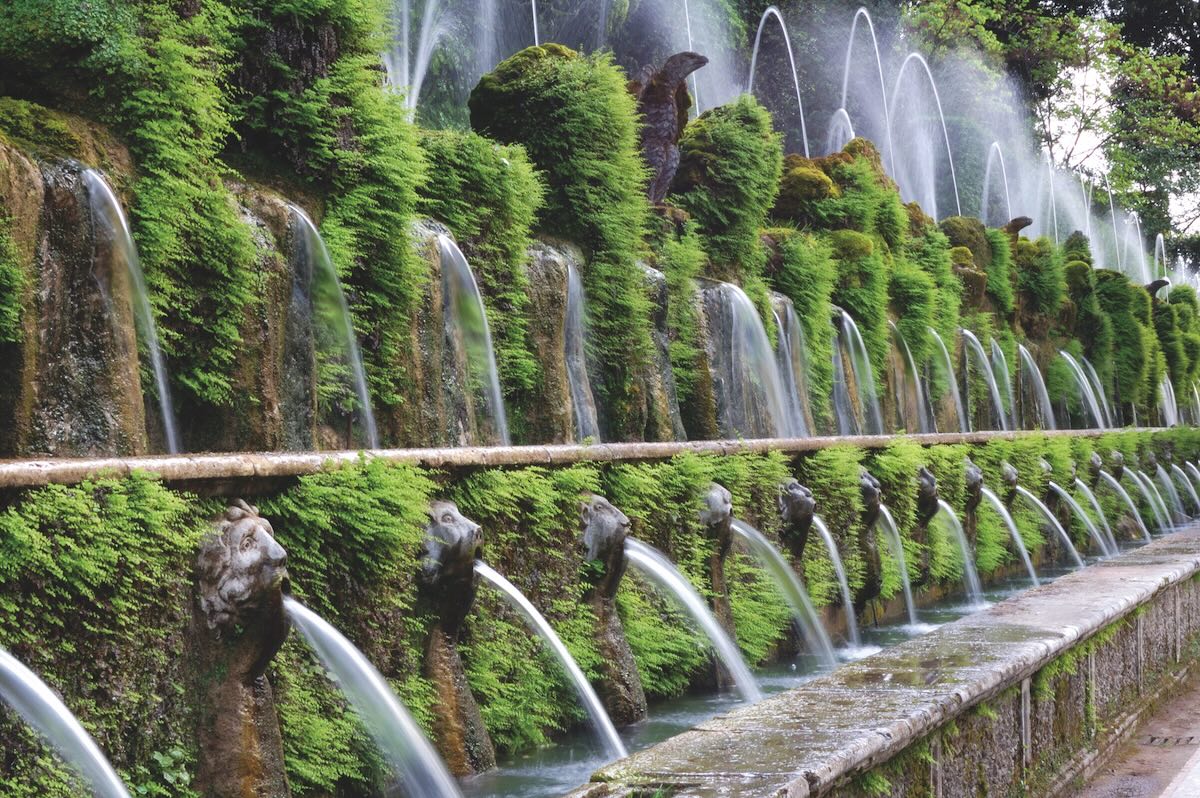
Photo by AA World Travel
"Avenue of the Hundred Fountains" at Villa d'Este in Tivoli features nearly 300 waterspouts across three channels.

Photo by Melanie Nashan
At Sacro Bosco, monstrous 16th-century carvings were intended to be astounding rather than pleasing, although visitors today delight in flocking to Orcus, known as "Mouth of Hell."
VILLA LANTE IN BAGNAIA Forty-seven miles north of Rome and home of the magnificent world-renowned Pegasus statue as well as an iconic scrolling water chain, Villa Lante was created in 1568 when Cardinal Gianfrancesco Gambara hired architect Giacomo Barozzi da Vignola. Vignola then called in a hydraulics expert to make the complex water magic happen. The thrills are many, including water features galore, a grotto, surprise water jets, impressive statuary, and parterres.
BOBOLI GARDENS IN FLORENCE If classical sculpture speeds your heart, go to Boboli Gardens in Florence, home of the Medici Grand Dukes of Tuscany. Niccolò Tribolo began work on the gardens in 1549, followed by Bernardo Buontalenti. Although this garden isn’t highly floral, it boasts 11 acres of phenomenal statues. You’ll find all the mythical greats—including Neptune and Bacchus—in addition to Buontalenti’s ornate grotto.
ISOLA BELLA ON LAKE MAGGIORE, NORTHERN ITALY In 1632, when Carlo III of the House of Borromeo decided to build a palazzo to honor his wife, he opted for an island as the setting, resulting in a confection of terraced gardens accented by flower-filled parterres. Niches are filled with statuary, waterlilies float in ponds, and seashells are a recurring motif.
GARDEN OF NINFA Picture wisteria vines lazily draping over medieval ruins along with bridges arching over the rose-festooned banks of streams and you’ve captured the essence of Ninfa, located southeast of Rome. Known for 2,000 years as the place of running water, Ninfa was transformed from mosquito-infested ruins into a garden in the 20th century. If you see an English influence, that’s the input of Brits who married into the Caetani family, bringing their love of plant rarities into the picture and earning Ninfa the designation as a plantsman’s paradise.